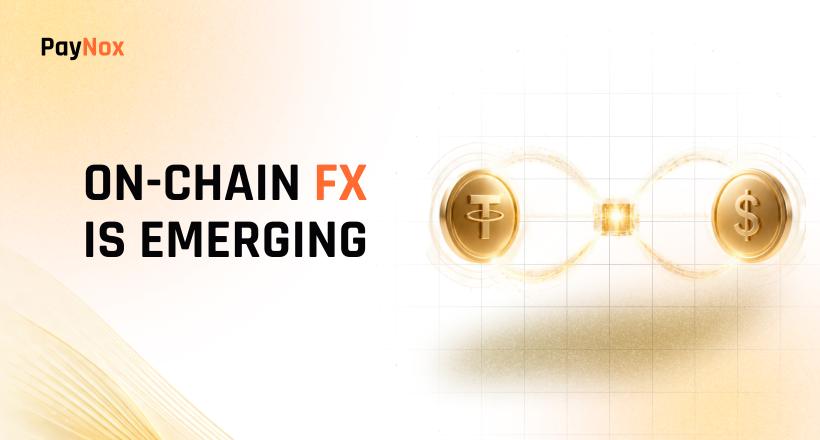
On-Chain FX Is Emerging
Foreign exchange is one of the largest and most liquid markets in the global financial system. Trillions of dollars move daily across currencies, supporting trade, investment, and international operations.
Yet the infrastructure behind FX remains deeply traditional.
Settlement often relies on correspondent banking networks, introducing delays, costs, and dependencies. Transactions can take time to finalize, and access is frequently limited by geography and institutional relationships.
This creates friction in a system that demands speed and efficiency.
From Intermediated FX to Direct Exchange
On-chain FX introduces a different model.
Instead of relying on multiple intermediaries, currency exchange can be executed directly on blockchain infrastructure. Digital representations of currencies — whether stablecoins or tokenized fiat — allow value to move seamlessly across networks.
This reduces the need for traditional clearing mechanisms and enables near real-time settlement.
At the same time, transparency increases. Transactions are recorded on-chain, making the flow of value more visible and auditable.
Why This Shift Matters
The implications go beyond speed.
On-chain FX enables programmable exchange. Currency conversion can be embedded directly into financial logic — triggered by conditions, integrated into smart contracts, and executed automatically.
This transforms FX from a standalone service into a component of a broader financial system.
For businesses, this means more efficient cross-border operations. For financial platforms, it enables the creation of new products that integrate exchange, settlement, and liquidity management into a single flow.
Pressure on Traditional Forex Infrastructure
As on-chain FX grows, it introduces direct competition to traditional forex systems.
Banks and financial institutions have historically controlled access to currency exchange. Their role has been central to settlement, pricing, and liquidity provision.
However, blockchain-based systems challenge this model by reducing reliance on centralized intermediaries.
This does not mean traditional FX disappears. Instead, it signals the emergence of a parallel infrastructure — one that is faster, more flexible, and globally accessible.
Toward a New FX Layer
The development of on-chain FX reflects a broader shift in financial architecture.
Markets are moving toward systems where value transfer, exchange, and settlement are integrated into programmable environments.
In this context, FX is no longer just about exchanging currencies. It becomes part of a unified infrastructure where liquidity moves continuously and efficiently.
The transition is still in its early stages, but the direction is clear.
On-chain FX is not just an innovation — it is a redefinition of how global currency exchange operates in a digital financial system.