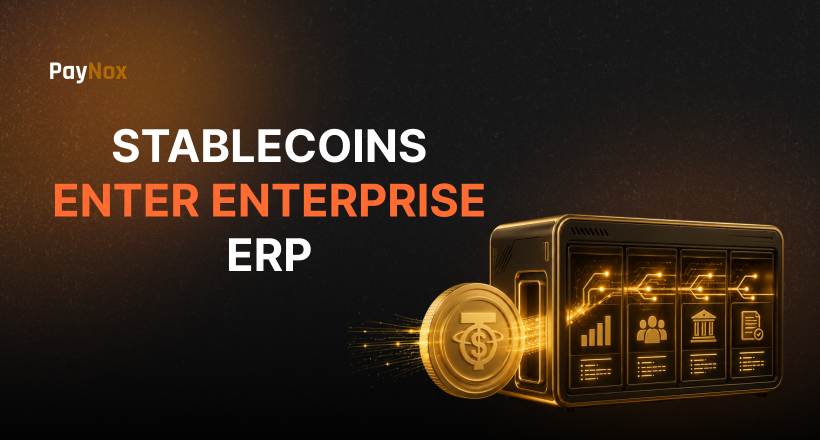
Stablecoins Enter Enterprise ERP
Stablecoins are moving into a new phase of enterprise adoption. Until recently, businesses often treated them as a separate payment layer: funds moved through a wallet, while accounting, treasury, reconciliation, and financial reporting remained inside traditional enterprise systems. 🏢
That separation is beginning to disappear.
As stablecoin infrastructure matures, digital money is increasingly positioned to connect directly with ERP platforms and the software businesses already use to manage financial operations.
From external payment to enterprise workflow
A stablecoin transaction can be fast and efficient, but businesses need more than payment execution.
Every transaction eventually needs to become part of accounting records, cash positions, treasury decisions, reconciliation processes, and internal reporting.
When these systems remain disconnected, finance teams must bridge the gap through additional integrations or manual processes.
ERP integration changes that model. 🔄
Instead of treating stablecoin activity as an external crypto event, businesses can bring it directly into existing financial workflows.
Digital money meets enterprise software
The significance of ERP integration goes beyond convenience.
Connecting stablecoin payments with enterprise software can create greater visibility across financial operations. 📊
A payment can be associated with the relevant invoice, reflected in accounting records, included in treasury positions, and tracked through settlement without creating an entirely separate operational layer.
This is where stablecoins begin to look less like a crypto product and more like financial infrastructure.
Why integration matters
Enterprise adoption depends heavily on how easily new technology fits into existing operations.
Companies are unlikely to rebuild their entire financial architecture simply to support a new payment rail.
The stronger model is integration. 🌐
Stablecoin infrastructure can connect with ERP, accounting, treasury, and payment systems while allowing businesses to maintain the workflows and controls they already understand.
This reduces fragmentation and gives finance teams a more unified view of capital movement.
From wallets to the financial stack
Stablecoins will continue to exist in wallets, but their enterprise potential extends much further.
When digital money becomes connected to the systems responsible for managing corporate finance, it can become part of everyday business operations rather than a separate financial experiment. 💳
That transition could be critical for broader institutional adoption.
Final thought
The next major stablecoin milestone may not be another consumer wallet or crypto application.
It may be something far less visible: native integration with enterprise financial software.
As stablecoins enter ERP infrastructure, the distinction between traditional and digital financial operations begins to narrow. 📈
Digital money is not simply entering the enterprise.
It is becoming part of how the enterprise operates.