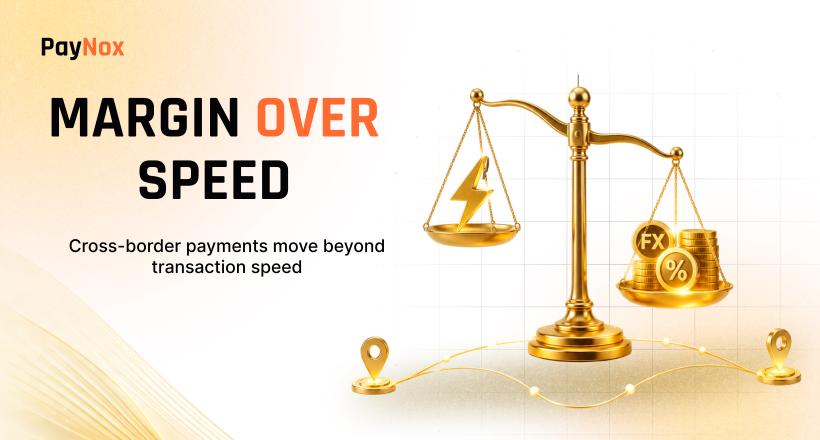
Margin Over Speed
Cross-border payments have spent years competing on one metric: speed. Faster transfers, faster settlement, and faster access to funds became the industry’s primary value proposition. ⚙️
Today, that advantage is becoming the baseline.
Businesses increasingly expect international payments to move quickly. What they are looking for now is something more valuable: better economics throughout the entire payment journey.
Why speed is no longer enough
A payment can settle in seconds and still be inefficient.
Poor routing decisions, unnecessary FX conversions, fragmented liquidity, and unpredictable settlement can increase operational costs even when the transfer itself is fast. 🔐
That is why payment providers are changing their priorities.
Instead of asking, “How fast can this payment move?” the better question is, “How efficiently can this payment reach its destination?”
The new competitive layer
Cross-border infrastructure is becoming an optimization engine.
The best payment route is no longer simply the shortest one. It is the route that balances liquidity availability, FX efficiency, settlement certainty, compliance requirements, and operational costs.
Every routing decision affects the final economics of the transaction. 🧩
For businesses processing international payments at scale, these improvements can have a meaningful impact on margins, cash flow, and customer experience.
Infrastructure that protects value
Modern payment infrastructure is evolving beyond transaction execution.
It now combines routing intelligence, liquidity management, foreign exchange optimization, and settlement orchestration into one coordinated system. 📊
Instead of optimizing only for speed, businesses are optimizing for predictable outcomes.
That means fewer hidden costs, stronger liquidity utilization, more reliable settlement, and greater operational visibility.
Final thought
Speed will always matter. But in the next generation of cross-border payments, it will no longer be enough. ✨
The companies that build the greatest advantage will not simply move money faster—they will move it smarter, preserving margin while delivering reliable and efficient global payments. 🚀