Interoperability Wins
The payments industry is entering a new phase of competition. For years, payment providers differentiated themselves by supporting more countries, more currencies, and more payment methods. Today, those capabilities are becoming the market standard. ⚙️
The next competitive advantage is interoperability.
Businesses no longer need isolated financial services. They need infrastructure where multiple systems work together as one connected ecosystem.
Beyond payment coverage
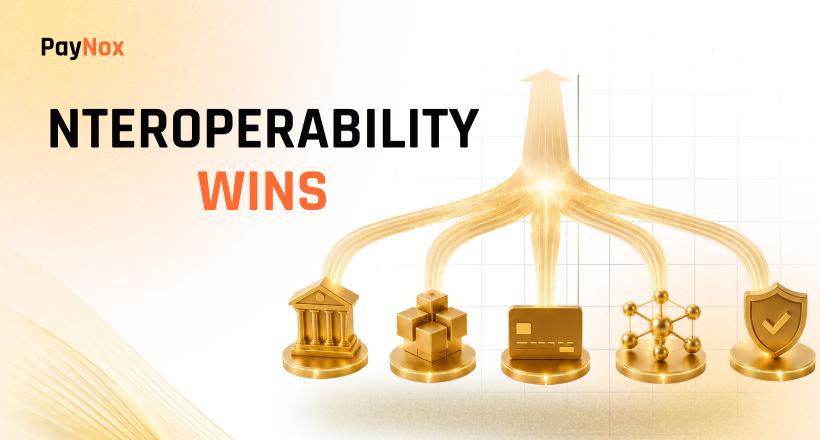
A modern payment transaction often touches several infrastructure layers before it is completed.
It may involve banking rails, blockchain networks, liquidity providers, foreign exchange, compliance systems, custody solutions, and settlement engines. 🔐
Adding more integrations is valuable, but only if those integrations communicate efficiently.
Without interoperability, payment operations become fragmented. Teams lose visibility, workflows become more complex, and operational costs increase.
Connected systems create stronger infrastructure
Interoperability is the ability to connect different financial environments into one coordinated payment flow. 🧩
Instead of managing separate systems independently, businesses benefit from infrastructure where every layer shares information, supports automation, and contributes to a predictable transaction lifecycle.
This reduces friction while improving transparency, scalability, and operational efficiency.
Why it matters for the future
As digital finance continues to evolve, payment providers will compete less on the number of features they offer and more on how effectively those features work together. 📊
The strongest infrastructure will connect fiat and blockchain, liquidity and settlement, compliance and banking, without forcing businesses to manage unnecessary complexity.
For merchants, fintech companies, and payment platforms, interoperability creates flexibility while simplifying operations.
Final thought
The future of payments is not built on isolated services—it is built on connected infrastructure. ✨
The providers that create seamless interoperability across financial systems will define the next generation of global payment experiences. 🚀