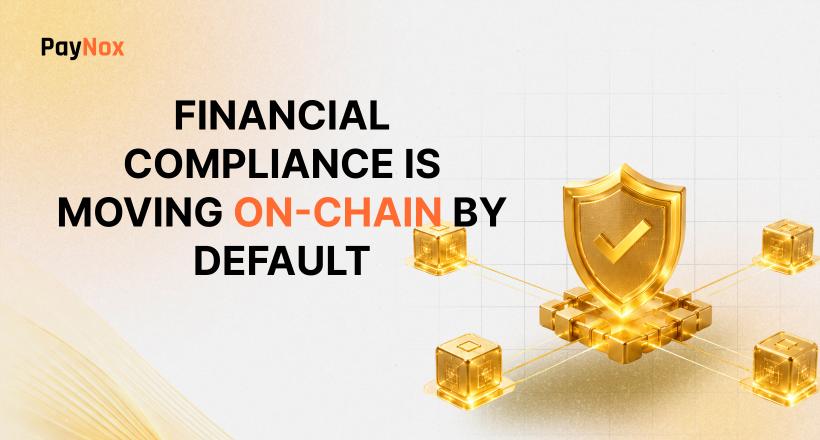
Financial Compliance Is Moving On-Chain by Default
Financial compliance is changing from a separate control process into a built-in part of modern payment infrastructure. ⚙️
For many years, compliance worked as a layer that came after the transaction. First, money moved. Then came checks, monitoring, reporting, reconciliation, and verification. This approach made sense in traditional systems, where financial processes were fragmented across banks, payment providers, intermediaries, and internal operational teams.
But digital finance is moving faster than this old model can support.
Today, crypto payments, tokenized assets, cross-border settlement, and digital banking infrastructure require a different approach. Compliance cannot remain only a final checkpoint. It needs to become a default layer built into the transaction flow from the beginning.
Why the old compliance model is no longer enough
Traditional compliance often depends on delayed visibility. A transaction is processed, and only after that do teams review risk signals, verify details, or investigate irregularities. 🔍
In complex payment environments, this creates friction. Businesses may face unclear transaction statuses, slow reviews, duplicated checks, or fragmented reporting between crypto and fiat systems.
For companies operating across digital assets and traditional finance, this is not only an operational issue. It affects trust, speed, scalability, and confidence in the whole payment process.
The market now needs infrastructure where compliance does not simply react to activity. It needs systems where compliance is already part of how activity is structured.
Compliance as a default layer
The key shift is simple: compliance is moving from “after the transaction” to “inside the transaction infrastructure.” 🔐
This means verification, monitoring, and transaction logic can be connected much earlier in the payment flow. Instead of treating compliance as an external review, businesses can build it into the system layer itself.
On-chain infrastructure makes this direction more realistic because it allows transaction data, asset movement, and verification logic to exist in a more transparent environment. Each action can become easier to trace, confirm, and audit.
This does not remove the need for regulation or professional risk management. But it changes where compliance sits inside the financial process. It becomes closer to the source of the transaction.
Why on-chain infrastructure matters
On-chain systems create a different level of visibility. Transaction records can be structured, traceable, and connected to programmable rules. This gives financial businesses a stronger foundation for monitoring movement, confirming activity, and maintaining cleaner audit trails. 🧩
For crypto-to-fiat payments, this is especially important.
These flows often involve multiple layers: blockchain networks, liquidity providers, payment gateways, banking partners, compliance systems, and settlement channels. If compliance is disconnected from this infrastructure, the entire process becomes harder to manage.
When compliance is embedded earlier, businesses gain better control over the full transaction lifecycle.
What this means for businesses
For businesses, the value is not only regulatory alignment. It is operational clarity. 📊
Built-in compliance can support more predictable transaction flows, clearer reporting, stronger internal controls, and faster decision-making. It helps teams understand what happened, where it happened, and whether the transaction passed the required checks.
This is critical for fintech companies, crypto payment providers, merchants, and platforms working across borders.
In this environment, compliance should not be seen only as a restriction. It becomes part of the trust infrastructure that allows digital finance to scale responsibly.
The future of financial compliance
The next stage of financial infrastructure will not be defined only by faster payments or broader access to digital assets. It will also be defined by how well systems can combine speed with visibility, compliance, and control. 🌐
Compliance is moving on-chain because the market needs more transparent and reliable transaction environments.
The strongest financial systems will be those where compliance is not added at the end, but designed into the foundation from day one. ✨
Final thought
Financial compliance is no longer just a post-transaction process.
It is becoming a default layer of digital payment infrastructure — built into the way transactions are created, verified, monitored, and settled. 🚀
For businesses working between crypto and fiat, this shift is not cosmetic. It is the difference between managing compliance as a burden and using it as a foundation for trust, scalability, and long-term financial infrastructure.