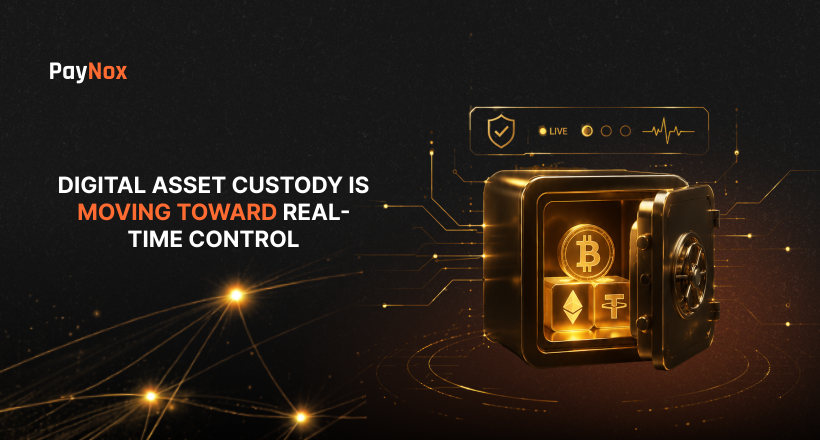
Digital Asset Custody Is Moving Toward Real-Time Control
Digital asset custody is changing. It is no longer only about keeping assets safe in a secure wallet or vault. Today, businesses need custody systems that provide control in real time. ⚙️
For years, custody was mostly associated with storage: private keys, cold wallets, access protection, and security policies. These elements are still essential. But digital finance is becoming faster, more connected, and more operationally complex.
That means secure storage alone is not enough anymore.
From passive storage to active control
In modern digital asset infrastructure, assets are not static. They move between wallets, exchanges, payment systems, liquidity providers, settlement channels, and fiat rails. Every movement can create operational, financial, or compliance risk. 🔐
This is why custody is moving from passive protection to active control.
Businesses need to know what is happening with their assets at the exact moment it happens. They need visibility into balances, permissions, transaction status, approval rules, and asset movement.
The question is no longer only: “Where are the assets stored?”
The better question is: “Who can access them, what is happening now, and can we react immediately?” 🧩
Why real-time control matters
Real-time control helps businesses reduce uncertainty. If a transaction is pending, restricted, approved, delayed, or moving through a specific route, teams need to see it clearly.
This is especially important for fintech companies, crypto payment providers, exchanges, and platforms working between crypto and fiat systems. In these environments, custody is connected to payments, liquidity, compliance, and settlement.
When custody systems are disconnected from real-time operations, businesses lose visibility. When they are connected, teams can manage risk faster and make decisions with more confidence. 📊
Custody as infrastructure
The future of custody is not just a safer vault. It is an active infrastructure layer.
Strong custody systems will combine security with permissions, monitoring, approvals, reporting, and operational control. They will help businesses protect assets and manage how those assets move through the financial system. 🌐
This does not make security less important. It makes security more practical. Protection becomes stronger when it is connected to live data and real-time action.
Final thought
Digital asset custody is moving toward real-time control because the market needs more than storage. It needs visibility, speed, permissions, and immediate reaction. ✨
The strongest custody infrastructure will not only protect digital assets. It will help businesses understand, manage, and control them at every stage of movement. 🚀