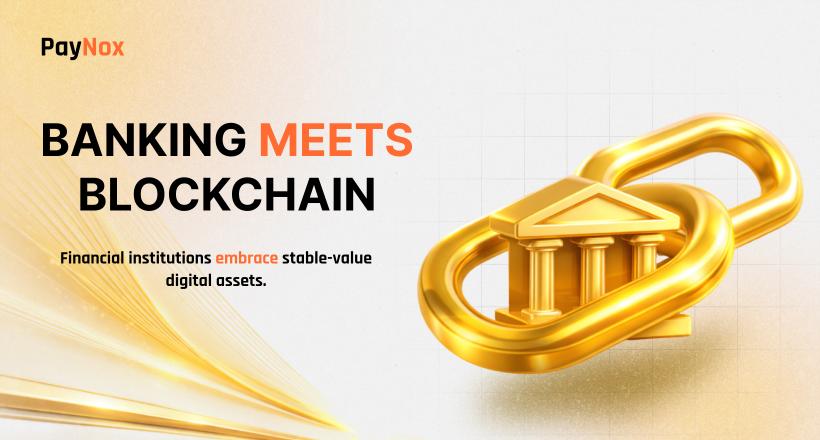
Banking Meets Blockchain
Financial institutions embrace stable-value digital assets.
Banks entering the stablecoin market marks one of the most important structural shifts in modern finance. What once seemed like an experimental segment dominated by crypto-native issuers is now becoming a field where traditional institutions see strategic advantage. The adoption of bank-issued stablecoins is not a trend — it is the modernization of payment infrastructure itself.
A new internal architecture for payments
Bank-issued stablecoins are increasingly integrated into internal settlement systems. Instead of relying on legacy messaging rails, banks can now settle transactions nearly instantly, reconcile positions automatically, and reduce operational risk. Stable-value assets provide the speed of digital money with the stability required for institutional-grade finance.
Programmable liquidity and automated flows
Using stablecoins allows treasury departments to automate multi-step payment workflows, including cross-border transfers, collateral movement, and on-chain assurances. This programmability was previously impossible within traditional rails. Blockchain becomes not a replacement for banking, but an enhancement that makes financial operations more responsive and globally synchronized.
The new competitive landscape
For years, private stablecoin issuers shaped the digital dollar market. But with regulated banks now issuing their own assets, the landscape is changing. Banks bring compliance, trust, and large-scale distribution — elements that accelerate institutional adoption. Private issuers, meanwhile, continue to lead in innovation and global accessibility.
The result is a dual ecosystem: regulated bank stablecoins on one side, open-market issuers on the other — both driving the next evolution of digital money.
A defining shift in global finance
This convergence of banking and blockchain represents more than technological adoption. It signals a new global standard for payments, one where stable-value digital assets support commerce, settlement, and liquidity across borders. Banks aren’t stepping into crypto — they’re redefining money itself.